
We are the Creative Ones...
This is the work that calls our names.
A call to a dear friend. That’s all it took.
He said: You don’t have to tell the story we’ve been listening to. You can tell the story we need to hear.
We were talking about data and logic models. About GLADYS. About the overwhelming evidence of need — and the harder question underneath it: how do we define effectiveness?
I went back to the drawing board. Not disappointed. Not ashamed. Just reminded of how hard it is to be creative. Because our measurement often becomes the story that repeats. How do we tell a new story?
And then it came: creativity is the thing. Not better compliance. Not faster execution of old ideas. Creativity. Leaders with the courage to turn left when everyone is going right. Leaders who refuse to be silent. Leaders who know we have to make a way out of no way — and who understand that the knowledge needed to transform our schools may not yet exist in any book, any dataset, any framework we currently hold.
We have research. We know what to do. But knowing how that knowledge lives in the body, how it sits on the tongue, how it moves through the hands — that knowing is still emerging. That knowing runs on imagination and emerges in practice.
Khalil Gibran Muhammad offered us a lens: in an instant, historically speaking, four million people shifted from being treated as property to being recognized as human beings and then as would‑be citizens. What once seemed impossible became reality. Yet most white Americans did not transform at the same pace, and this stagnation of imagination — this failure of creative vision — was embedded into law and baked into what we measure and evaluate.
So here is the design challenge. Instead of measuring achievement gaps — a metric that installs white performance as the ceiling and the standard — what if we tracked creativity? What if we measured how alive our leaders are to possibility? How do you measure that? I don’t know yet. That’s the point. That’s the work.
Maybe we stop repeating old solutions to old problems. Maybe we come at the same problems from a completely different angle — one that pulls all of us all into the mystery, the unknown, the new territory of creation. Where no one already has the answer. Everyone has part of the answer. Where the contribution is equal because the problem is genuinely unsolved.
That’s the story we need to hear. That’s the story that we need to write.
Stay Creative and Stay Maladjusted,
Caroline
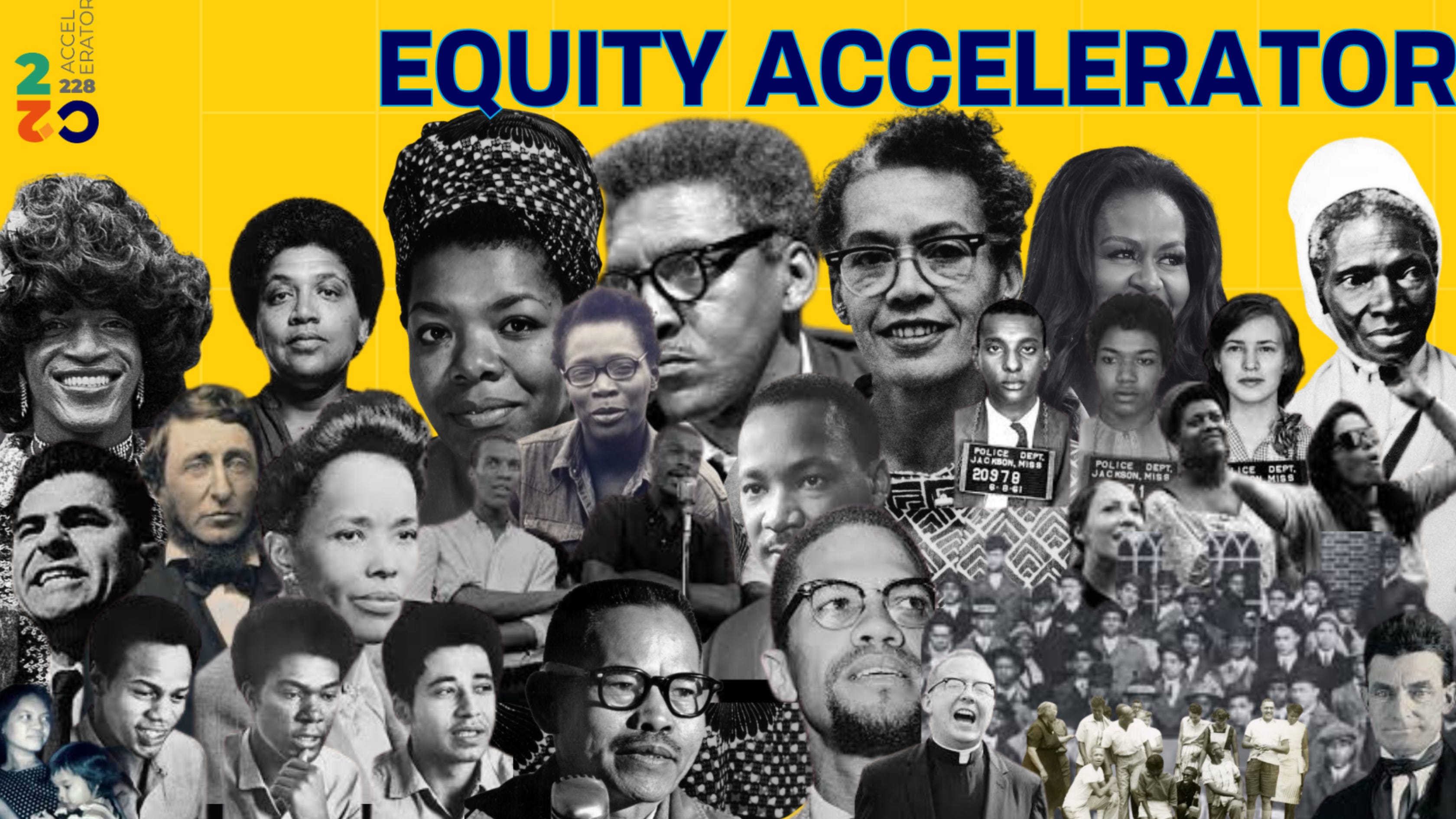
(It’s Malcolm X’s birthday, y’all, and we have a treat for you!)
Free Equity Work: Malcolm X - The Ballot or the Bullet
“We don’t see any American dream. We’ve experienced only the American nightmare. We haven’t benefited from America’s democracy. We’ve only suffered from America’s hypocrisy.”
Every May 19th, we pause.
Not to perform. Not to post. To actually read.
Malcolm X’s “The Ballot or the Bullet” — delivered in 1964 — is one of the most precise diagnoses of institutional power ever spoken aloud in America. In it, he makes an argument that equity leaders are still having to make today: that political and economic self-determination are not separate from the work of justice. They are the work.
He draws a line between personal faith and collective strategy. Between sentiment and structure. Between the language of civil rights — which asks the powerful for permission — and the language of human rights, which doesn’t.
That distinction lives inside everything we build at 228 Accelerator.
This month’s Free Equity Work resource is the full speech — paired with historical context and three reflection questions for your team or your own practice.
It’s an invitation to sit with the kind of clarity that doesn’t make institutions comfortable. Which is, of course, exactly why we still need it.
Happy birthday, Brother Malcolm.
“Once you change your philosophy, you change your thought pattern. Once you change your thought pattern, you change your attitude.
Once you change your attitude, it changes your behavior pattern, and then you go on into some action.”
GLADYS Pilot: AI Literacy + Equity Leadership? Yes!
Most AI professional development asks you to learn a tool. This asks something harder.
The GLADYS Pilot Learning Plan is a six-month curriculum designed for equity leaders who want to develop real AI literacy — not the kind that teaches you to prompt better, but the kind that asks: what is this tool actually doing, who benefits from it, and what does it reveal about you?
Across six months, leaders move through the equityXdesign 3.0 curriculum while running five simultaneous investigations. Three track the AI co-pilot — what personalization looks like, whether it serves the mission, and what it costs to show up with this technology inside equity work. Two track something the field rarely names: the conditions that creative leadership requires, and where that creative energy goes when the institution pushes back.
The reading is all free. It runs from Timnit Gebru’s suppressed AI ethics paper to Black Reconstruction to somatic practice. Every text earns its place.
By Month 6, each leader has a data story — six months of evidence about their own proximity, language, and creative capacity. That is what AI literacy looks like when equity is the frame.
Gladys. Accelerating the human relationships that change something significant.
Thanks for reading The Praxodox: Remaking Ourselves and Our Relationships!
This post is public, so feel free to share it.