
Quest 23: Compare the Models and Tools
So that the Reb's can't cheat me...
“As the Freedmen's Bureau superintendent observed, "I saw one [labor contract] in which it was stipulated that one-third of seven-twelfths of all corn, potatoes, fodder, etc., shall go to the laborers." Hence when a middle-aged black woman was asked why she was so determined to learn to read and write, she replied, "so that the Rebs can't cheat me." - Education of Blacks in the South- James Anderson 1860–1935
Goal: To develop AI fluency by understanding how large language models work, distinguishing between different types of models (general vs. reasoning), and recognizing the difference between generative and agentic AI — so you can apply the right tool to the right real-world problem with discernment.
This is not about hype.
This is about judgment.
And remember: the field is evolving quickly. By the time you are reading this, there may be new models or capabilities. Your aim is not to memorize product names — it’s to understand principles that transfer across tools.
Role: You are a Model Explorer. Not a passive user. Not a cheerleader. Not a skeptic standing outside. You are an investigator of thinking systems. Your job is to observe how models structure responses, notice differences between speed and depth, identify strengths and weaknesses, reflect on what kind of cognition each system amplifies.
You are building discernment and the confidence to share with others.
Audience: Your team and community.
That is literacy in this era.
Situation: We are living through another Reconstruction. After the Civil War, the United States had to renegotiate labor, capital, and citizenship. Du Bois argued that slavery was not marginal to capitalism but foundational, and Reconstruction sought to rebuild the nation’s moral and economic architecture. Today, artificial intelligence is again reshaping labor, ownership, and value. Economic systems do not vanish; they evolve. If earlier generations had to read contracts and ballots, we must now read algorithms. Large Language Models predict patterns from historical data, inheriting its assumptions. Without discernment, they risk scaling inequality rather than transforming it.
Within this ecosystem, you will encounter:
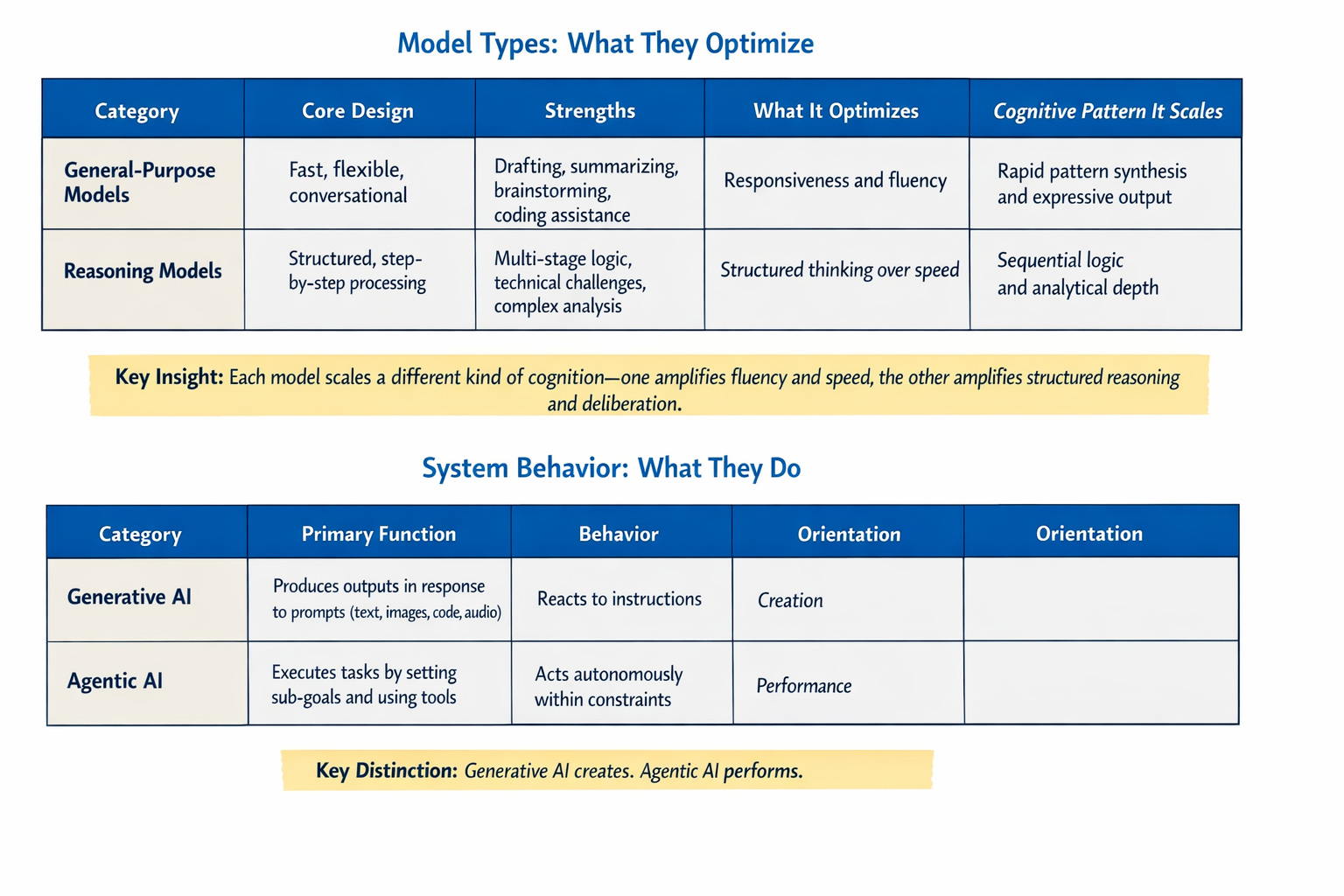
Performance: Approach this work with disciplined observation and reflection. Choose one general-purpose model and one reasoning model, and give both the same complex prompt. Compare their speed, structure, confidence, assumptions, and moral framing. Then push further. Ask each model what it is optimizing for, request a critique of its own response, identify missing data or perspectives, and consider who might be harmed by uncritical reliance. Finally, zoom out. Examine the worldview embedded in each output, whose labor remains invisible, who owns the infrastructure, and what happens if these systems scale. Discernment means evaluating not just answers, but the systems producing them. (see the worksheet below)
Product: Produce a short AI Fluency Brief (1–2 pages or 5–7 slides) that clearly explains, in beginner-friendly language, how Large Language Models work, including how they predict patterns and why probability differs from human reasoning. Include a comparison chart distinguishing General vs. Reasoning models and Generative vs. Agentic AI. Document your observations from experimentation, noting differences in speed, structure, assumptions, confidence, and moral framing. Offer three practical recommendations: when to use each type, risks to monitor, and essential questions leaders should ask. Conclude with a reflection on what surprised you and share your learning with two others to build collective literacy.
Complete the sentence: As I reconsider AI, I used to think______________, but now I know_________ .
Resources:
